Peer-to-peer payment apps like Venmo, PayPal, Cash App, and Zelle have become a standard part of how Americans send money, pay for services, and run small businesses. In 2025 alone, Zelle processed over $1.2 trillion in payments, with nearly 30% of all transactions involving small businesses. As P2P volume grows, so does the IRS's interest in making sure business income flowing through these platforms gets reported. If you use any payment app to accept money for goods or services, understanding the current reporting rules is essential to staying compliant and avoiding surprises at tax time.

How Form 1099-K Works for P2P Payments
Form 1099-K is the IRS information return used to report payments you receive for goods and services through payment cards (credit or debit) or third-party settlement organizations (TPSOs) like Venmo, PayPal, and Cash App. When a TPSO issues you a 1099-K, it also sends a copy to the IRS, creating a paper trail for the income you received through the platform.
It is important to understand that Form 1099-K only applies to payments for goods and services. Money you receive from friends and family for personal purposes (splitting a dinner bill, a birthday gift, or reimbursing a roommate for rent) is not taxable and should not appear on a 1099-K. Most platforms allow you to tag transactions as personal or business when you send or receive money.
The Current 1099-K Reporting Threshold (2025 and Beyond)
The reporting threshold for Form 1099-K has gone through significant changes in recent years. Here is the full timeline:
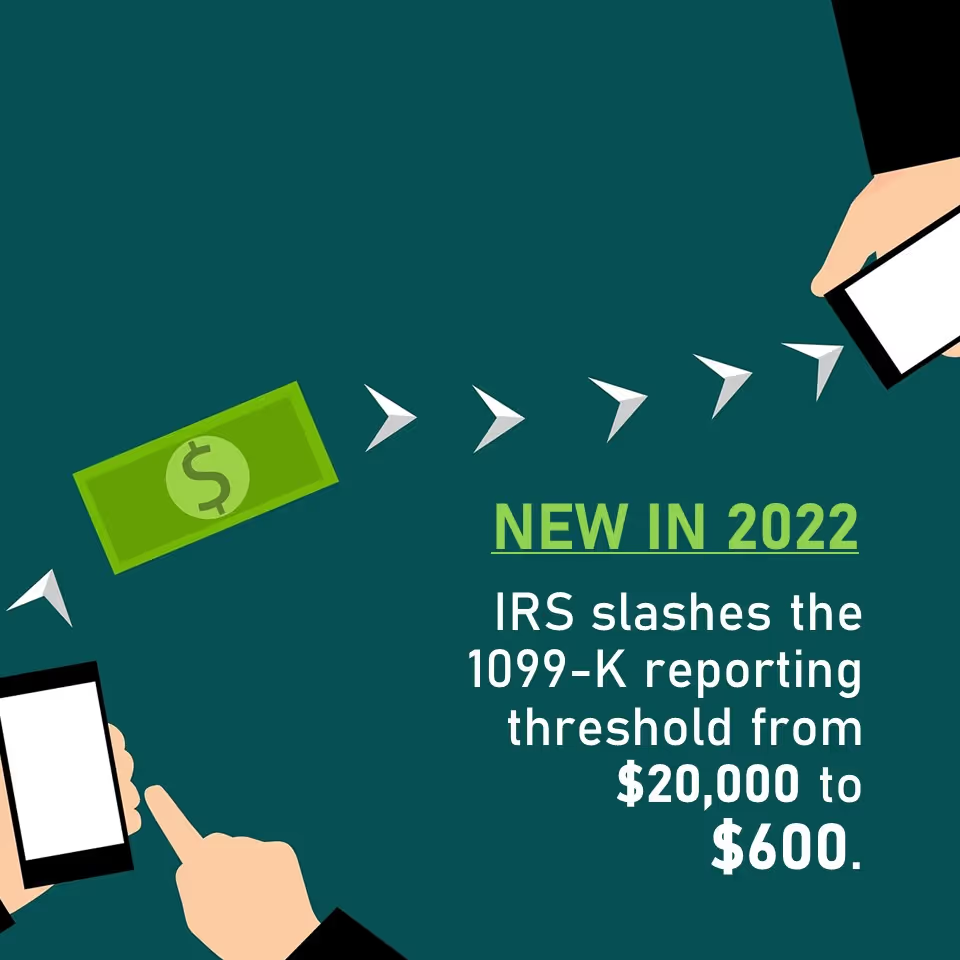
- 2011 through 2023: TPSOs were required to file Form 1099-K only when a payee received more than $20,000 and had more than 200 transactions in a calendar year.
- 2021 (American Rescue Plan Act): Congress reduced the threshold to $600 with no transaction minimum, scheduled to take effect for tax year 2022.
- 2022 and 2023: The IRS delayed implementation and kept the $20,000/200-transaction threshold in place.
- 2024: The IRS applied a transitional $5,000 threshold for TPSOs.
- July 4, 2025 (One Big Beautiful Bill Act): OBBBA permanently restored the original threshold of more than $20,000 and more than 200 transactions, retroactive to tax years beginning after December 31, 2021. The $600 threshold will not take effect.
The bottom line: for tax year 2025 and beyond, a TPSO must file Form 1099-K only if your gross payments for goods and services exceed $20,000 and you have more than 200 separate transactions on that platform in a calendar year. Both conditions must be met.
Payment Card Transactions Have No Minimum Threshold
One important distinction that catches many business owners off guard: the $20,000/200-transaction threshold applies only to TPSO payments (payment apps and online marketplaces). Payment card transactions (credit card, debit card, and stored-value card payments) have no minimum reporting threshold. If you accept even a single credit card payment for a service, your payment card processor is required to report that amount on Form 1099-K.
Zelle Is Different: No 1099-K Reporting
Not all P2P platforms are treated the same under IRS rules. Zelle does not issue Form 1099-K and does not report transactions to the IRS. This is because Zelle facilitates direct bank-to-bank transfers rather than holding funds as an intermediary. It is not classified as a TPSO under federal tax law.
However, this does not mean income received through Zelle is tax-free. If a client pays you for services via Zelle, that income is still fully taxable. You are responsible for tracking it and reporting it on your tax return (typically on Schedule C for sole proprietors). The difference is simply that the reporting burden falls entirely on you rather than on the platform.
If you are a business owner who receives payment through Zelle, the payer may still need to issue you a Form 1099-NEC if the total for the year exceeds $2,000 (the new threshold under OBBBA for tax year 2026 and later, up from $600).
State-Level Thresholds May Be Lower
The federal $20,000/200-transaction threshold is not the only trigger. Several states maintain their own lower reporting thresholds for Form 1099-K, and these do not automatically conform to federal changes. As of 2026, states with lower thresholds include:
- Maryland, Massachusetts, Vermont, Virginia: $600
- Illinois: $1,000 with four or more transactions
Arizona does not currently impose a state-level 1099-K threshold below the federal standard. Arizona residents follow the federal $20,000/200-transaction rule for TPSO reporting.
You Must Report All Business Income, Even Without a 1099-K
The most important rule is straightforward: you must report all taxable income on your federal return regardless of whether you receive a Form 1099-K. The $20,000/200-transaction threshold determines when the platform must file a report with the IRS. It does not change your obligation to report income.
If you earn $5,000 selling handmade goods through a marketplace, that income is reportable on your tax return even if the platform does not send you a 1099-K. Sole proprietors report business income on Schedule C (Form 1040). Self-employed individuals earning $400 or more in net self-employment income must also pay self-employment tax (15.3% covering Social Security and Medicare, with half deductible above the line).
Cryptocurrency and Digital Asset Reporting
The tax reporting landscape for digital assets has also evolved significantly. If you use a P2P app like Cash App or PayPal to buy, sell, or transfer cryptocurrency, additional reporting obligations may apply:
- Form 1099-DA: Starting with transactions on or after January 1, 2025, custodial digital asset brokers (including centralized crypto exchanges) must report gross proceeds from digital asset sales on Form 1099-DA. Cost basis reporting began for transactions after January 1, 2026.
- Capital gains rules: Digital assets are treated as property for federal tax purposes. Selling cryptocurrency for a gain triggers capital gains tax, whether you sold through a P2P app, an exchange, or a direct transfer.
- Form 8949: Individual taxpayers report digital asset sales on Form 8949, regardless of whether they receive a 1099-DA from a broker.
Practical Tips for P2P Users Who Accept Business Payments
Whether you are a freelancer, a small business owner, or someone selling items online, these steps will help you stay compliant:
- Separate personal and business transactions. Use a dedicated business account on payment platforms when possible, and tag transactions correctly (goods/services vs. personal).
- Keep detailed records. Maintain invoices, receipts, and a log of all income received through P2P platforms. The IRS considers P2P payments similar to cash and may require additional documentation to substantiate business deductions.
- Track income across all platforms. The 1099-K threshold applies per platform, not in aggregate. A payee receiving $15,000 on Venmo and $10,000 on PayPal would not cross the threshold on either platform, but both amounts are still taxable income.
- Plan for estimated taxes. If you receive significant business income through P2P apps, you may need to make quarterly estimated tax payments to avoid underpayment penalties.
- Review your 1099-K carefully. If you receive a 1099-K that includes personal (non-business) transactions, you can reduce the reportable amount on your return with a corresponding adjustment on Schedule C or Schedule 1.
Arizona Considerations for P2P Sellers
Arizona residents who sell goods or services through P2P platforms should be aware of transaction privilege tax (TPT), Arizona's version of a sales tax. If you are regularly selling tangible personal property or certain services through online platforms, you may be required to obtain a TPT license and collect the applicable city and state tax. This obligation exists independently of whether you receive a 1099-K.
Arizona's flat 2.5% individual income tax rate applies to all taxable income, including P2P business earnings. For proactive tax planning, consider how your P2P income interacts with federal self-employment tax, the qualified business income (QBI) deduction (which is now permanent under OBBBA), and Arizona's pass-through entity tax election.
K&R Strategic Partners is a tax advisory firm in Arizona working with owners across the Valley. Bring us your own numbers and we will tell you what actually applies.
Frequently Asked Questions
Do I owe taxes on money received through Venmo or PayPal?
You owe taxes on any money received as payment for goods or services, regardless of how you receive it. Personal transfers (gifts, splitting costs with friends) are not taxable. The platform's 1099-K reporting threshold does not change your obligation to report business income.
What is the 1099-K threshold for 2025 and 2026?
The federal 1099-K reporting threshold for TPSOs is more than $20,000 in gross payments and more than 200 transactions in a calendar year. This threshold was permanently restored by the One Big Beautiful Bill Act in July 2025. Some states maintain lower thresholds.
Does Zelle report my income to the IRS?
No. Zelle is a bank-to-bank transfer network and is not classified as a TPSO. It does not issue Form 1099-K or report your transactions to the IRS. You are still responsible for reporting any taxable business income you receive through Zelle.
What if I receive a 1099-K for personal transactions?
If your 1099-K includes amounts for personal transactions (such as selling a used item at a loss or receiving reimbursements from friends), you can reduce the reportable income on your tax return. Consult a tax professional to ensure the adjustment is documented correctly.
How does cryptocurrency affect my P2P tax reporting?
Cryptocurrency transactions are treated as property dispositions. If you buy or sell crypto through a P2P app, you may owe capital gains tax on any profit. Starting in 2025, custodial brokers report digital asset transactions on Form 1099-DA.
How K&R Taxes Can Help
Navigating P2P payment reporting, 1099-K rules, and digital asset compliance can be complex, especially for small business owners and self-employed individuals who use multiple platforms. At K&R Taxes, our team provides strategic tax advisory and preparation that accounts for all your income sources, identifies eligible deductions (including the QBI deduction and self-employment tax deduction), and keeps you in full compliance with both federal and Arizona tax requirements. If you are unsure how to handle P2P income, contact us for a consultation before your next filing deadline.