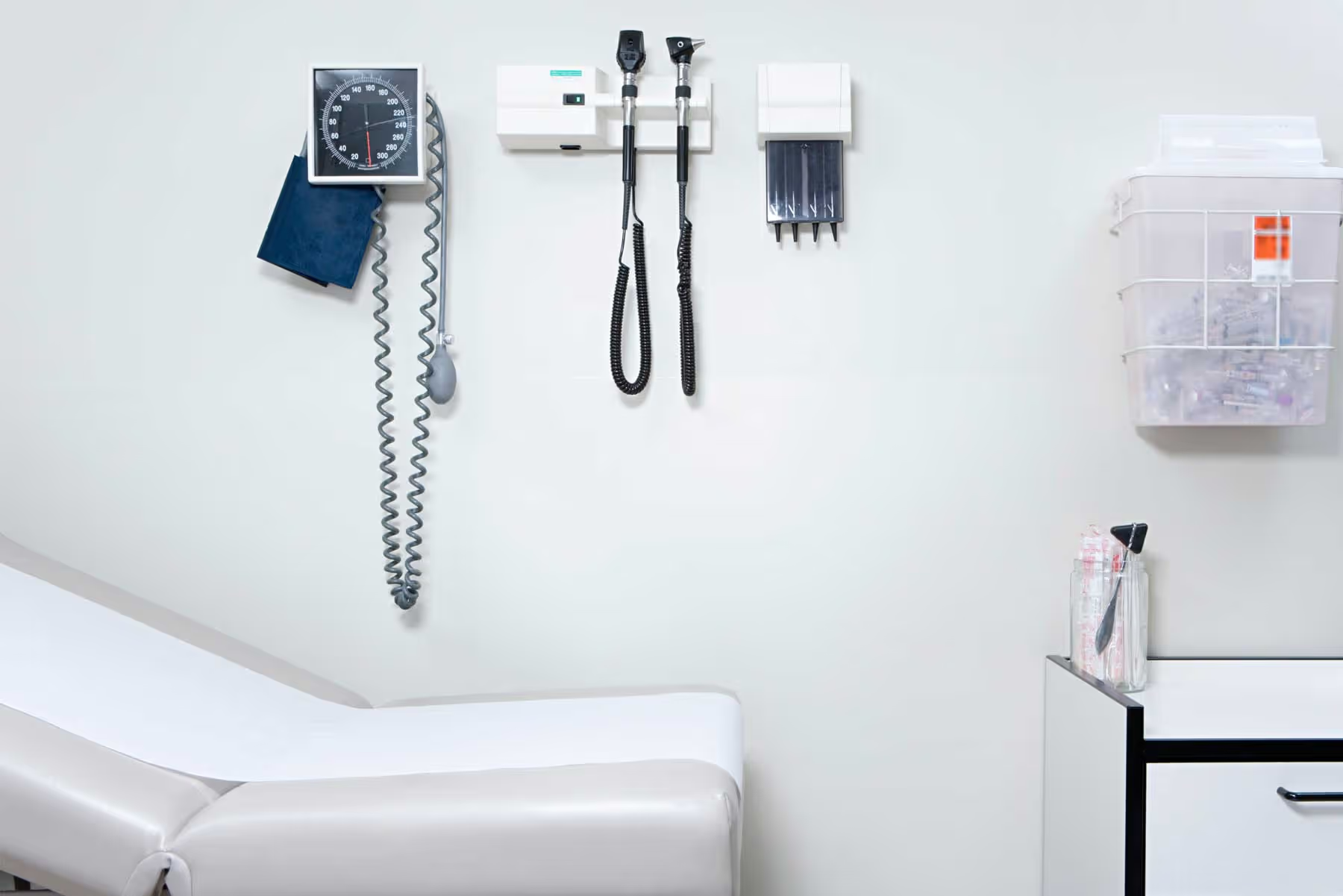
If you own or lease a medical or dental office building, you are likely depreciating the entire structure over 39 years under standard IRS rules. A cost segregation study can change that by reclassifying 20% to 40% of your building's cost basis into shorter depreciation categories, turning decades of small write-offs into a large first-year deduction. With 100% bonus depreciation now permanently restored under the One Big Beautiful Bill Act (OBBBA), the value of cost segregation for dental practice owners and medical professionals has never been higher.
What Is a Cost Segregation Study?
A cost segregation study is an engineering-based analysis that separates a commercial property's purchase or construction cost into its individual component assets. Instead of treating the building as a single 39-year depreciable asset, the study identifies components that qualify for shorter MACRS recovery periods under the Internal Revenue Code:
- 5-year personal property: dental chairs, delivery units, imaging equipment (CBCT, X-ray, panoramic), vacuum pumps, compressors, sterilization equipment, computers, digital scanners, exam-room casework, medical-gas piping (oxygen, nitrous oxide, vacuum lines), specialty plumbing, and clinical data cabling
- 7-year property: office furniture, certain specialized cabinetry, and larger imaging systems
- 15-year land improvements: parking lots, exterior paving, ADA ramps, landscaping, irrigation systems, signage, exterior lighting, sidewalks, and fencing
- 39-year property: the remaining structural shell (walls, roof, foundation)
Medical and dental offices contain unusually high densities of short-life assets compared to standard commercial properties. The specialty plumbing, dedicated electrical circuits for imaging suites, procedure-room lighting, and clinical infrastructure that define a dental or medical office are classified as 5-year personal property when properly documented by a qualified cost segregation engineer.
Why Dental and Medical Practices Are Ideal Candidates
Standard commercial offices typically reclassify 15% to 25% of total building cost into shorter-life categories. Dental and medical offices regularly hit 20% to 40% because the clinical fit-out is so equipment-intensive. On a $1.5 million dental practice building, that could mean $300,000 to $600,000 of basis moves from 39-year property into 5-year, 7-year, or 15-year classes.
With 100% bonus depreciation under OBBBA (permanent for property acquired after January 19, 2025), every dollar reclassified into a 20-year-or-shorter class is fully deductible in the year the property is placed in service. At the top federal rate of 37%, a $400,000 reclassification produces roughly $148,000 in first-year federal tax savings.
Bonus Depreciation and Section 179 After OBBBA
Before OBBBA, bonus depreciation under IRC §168(k) was phasing down: 80% in 2023, 60% in 2024, 40% in 2025, and heading to zero. The OBBBA reversed this entirely and made 100% bonus depreciation permanent for qualified property acquired and placed in service after January 19, 2025. IRS guidance confirmed the interim rules and acquisition-date requirements.
Property acquired on or before January 19, 2025, still follows the old phase-down schedule (40% for 2025 placements, 20% for 2026 placements). This timing distinction matters for practices that signed purchase agreements before the cutoff date.
In addition to bonus depreciation, dental practices can use the Section 179 deduction for qualifying equipment purchases. OBBBA raised the Section 179 limit significantly:
- Tax year 2025: $2,500,000 maximum deduction, phase-out begins at $4,000,000 in total qualifying property
- Tax year 2026: $2,560,000 maximum deduction, phase-out begins at $4,090,000 (per Rev. Proc. 2025-32)
Section 179 is computed first, then bonus depreciation applies to remaining eligible basis, then regular MACRS depreciation covers the rest. For a dental practice purchasing $500,000 in equipment and a $1.2 million building in 2026, the combined effect of Section 179 (for movable equipment) and cost segregation with bonus depreciation (for building components) can produce substantial first-year deductions.
The Self-Rental Exception and Passive Loss Rules
Many dentists and physicians own their office building through a separate LLC or S corporation and lease the space to their operating practice. This is a common liability protection strategy, but it creates a passive activity problem: rental real estate is generally passive under IRC §469, which means losses (including large depreciation deductions from cost segregation) cannot offset the active income from the medical or dental practice.
There are two key solutions for practice owners:
- Self-rental recharacterization: Under Treas. Reg. §1.469-2(f)(6), rental income from a self-rental property (where the taxpayer materially participates in the tenant business) is treated as nonpassive. However, this rule only recharacterizes income, not losses. Rental losses from the self-rental remain passive unless you also make a grouping election.
- Grouping election under IRC §469: By electing to group the rental activity with the operating practice as a single economic unit under Regs. §1.469-4, the cost segregation losses generated by the building can offset practice income. The election requires common ownership and economic interdependence, which most self-rental dental and medical arrangements satisfy. The election statement must be attached to the tax return for the first year the grouping applies.
Without addressing the passive loss rules, a cost segregation study on a separately held building could generate a large deduction that sits unused as a suspended passive loss. Any practice owner considering cost segregation on a self-rental property should discuss the grouping election with their tax advisor before filing.
Lookback Studies and Form 3115
Dental and medical practices that purchased or built their office years ago and never performed a cost segregation study have not lost their opportunity. The IRS allows a "lookback" or catch-up study through Form 3115 (Application for Change in Accounting Method, Designated Change Number 7). This is an automatic-consent filing that does not require prior IRS approval.
The process works as follows:
- A cost segregation specialist analyzes the property and reclassifies components into their correct shorter-life categories
- The preparer calculates the cumulative difference between depreciation actually claimed and the depreciation that should have been claimed under the shorter lives
- That cumulative difference is reported as a Section 481(a) adjustment on the current-year return
- The entire catch-up deduction is claimed in a single year, with no need to amend prior returns
The bonus depreciation rate that applies in a lookback study corresponds to the rate in effect when the property was originally placed in service. A building placed in service in 2021 qualifies for 100% bonus on its reclassified components. A building placed in service in 2024 qualifies for 60%. Buildings acquired after January 19, 2025, qualify for 100% permanently.
Leasehold Improvements and Tenant Buildouts
Owning the building is not required for a cost segregation study. Dental practices that lease their space and invest in tenant-specific buildouts (operatory plumbing, specialty electrical, imaging-room construction, custom cabinetry) can still benefit. Qualified improvement property (QIP) placed in service after 2017 has a 15-year MACRS life and is eligible for 100% bonus depreciation under OBBBA for property acquired after January 19, 2025.
A cost segregation study on a leasehold improvement identifies which components qualify for 5-year or 7-year treatment (personal property elements within the buildout) versus the 15-year QIP classification. This further accelerates the deduction timeline.
QBI Deduction Considerations for Medical and Dental SSTBs
Medical and dental practices are classified as Specified Service Trades or Businesses (SSTBs) under IRC §199A. The QBI deduction (20% of qualified business income) was made permanent by OBBBA, but SSTB owners face income-based phase-outs. For tax year 2026, the phase-out begins at $201,775 for single filers and $403,550 for married filing jointly.
Cost segregation can help here strategically: the large first-year depreciation deduction reduces taxable income, which may push a practice owner below the SSTB phase-out threshold, preserving some or all of the 20% QBI deduction. This creates a compounding tax benefit that goes beyond the depreciation savings alone.
Arizona Considerations
Arizona imposes a flat 2.5% individual income tax on all taxable income, with no separate brackets or surcharges. For dental and medical practice owners filing Arizona returns, federal cost segregation deductions flow through to the state return, producing an additional 2.5% state tax savings on every dollar of accelerated depreciation.
While the state savings are proportionally smaller than the federal benefit, they are automatic and require no separate election. Arizona has no state-specific cost segregation rules, no franchise tax for LLCs, and no state estate tax, so entity structuring decisions for the building (LLC, S corporation) can focus on federal tax optimization and liability protection.
K&R Strategic Partners is an Arizona tax accounting firm based at 6861 E Main St in Mesa. Bring us your own numbers and we will tell you what actually applies.
Frequently Asked Questions
How much does a cost segregation study cost?
Fees vary by property value and complexity. For a typical $1 million to $3 million dental or medical office, engineering-based studies generally range from $5,000 to $15,000. Some firms offer lower-cost options for smaller properties. The study almost always pays for itself many times over in first-year tax savings.
Is 100% bonus depreciation still available in 2026?
Yes. OBBBA made 100% bonus depreciation permanent for qualified property (MACRS property with a recovery period of 20 years or less) acquired and placed in service after January 19, 2025. There is no scheduled phase-down or expiration date.
Can I do a cost segregation study on a building I bought years ago?
Yes. A lookback study using IRS Form 3115 allows you to claim all previously unclaimed accelerated depreciation in a single tax year. No amended returns are required. The bonus depreciation rate applied matches the rate in effect when the property was originally placed in service.
What if I lease my office space instead of owning it?
A cost segregation study can still apply to your tenant improvements and buildout costs. Specialty plumbing, electrical, cabinetry, and clinical infrastructure installed by the tenant typically qualify for 5-year or 7-year treatment, while other qualified improvements fall under the 15-year QIP category.
Do passive loss rules prevent me from using the deduction?
If you own the building through a separate entity and lease it to your practice, the depreciation losses may be classified as passive. However, a grouping election under IRC §469 can allow these losses to offset your active practice income. Consult your CPA to determine whether a grouping election is appropriate for your situation.
How K&R Taxes Can Help
Cost segregation requires coordination between engineering analysis, depreciation calculations, passive loss planning, and entity structuring. At K&R Taxes, we work with dental and medical practice owners to determine whether a cost segregation study makes sense for their situation, connect them with qualified cost segregation engineers, handle the tax reporting and compliance, and ensure the depreciation strategy integrates with their broader tax plan. Whether you just purchased a building, completed a renovation, or have owned your practice location for years and never considered a lookback study, contact us to discuss your options. You can also explore our related guides on cost segregation for rental real estate and Section 179 deductions for additional tax planning strategies.